
Omaha’s Landfill Captures Methane. So Why Compost Your Food?
We hear this one a lot, often from people who know a fair bit about trash: Pheasant Point Landfill out by Bennington captures its methane and turns it into energy, so what's the harm in throwing food away?
The capture part is true, and it's a good thing. Since 2002, gas from Pheasant Point has fueled OPPD's Elk City Station, which makes enough electricity for nearly 4,000 homes. In May 2026, a $68 million plant opened at Pheasant Point that cleans the gas into renewable natural gas, enough for about 11,500 homes a year. That gas can fuel garbage trucks or go straight into the pipeline.
We're glad it's there. What it can't do is catch most of the methane that comes off food, and the reason has to do with timing. To see it, you need to know how a landfill works.
How a landfill works
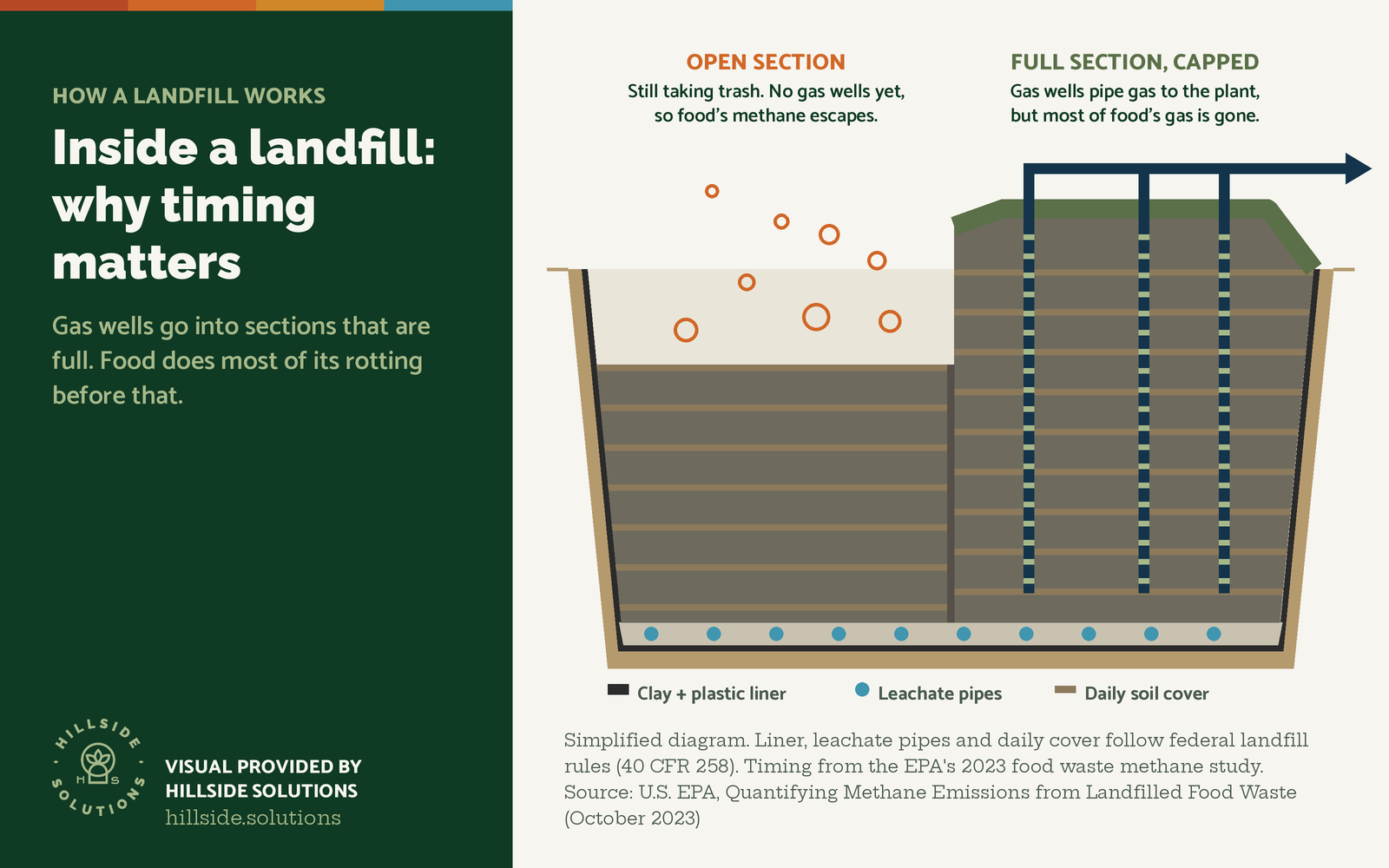
A modern landfill is built as a series of lined sections called cells. Federal rules require a liner at the bottom (compacted clay plus a thick plastic sheet) and pipes that collect leachate, the liquid that seeps out as trash breaks down, so it stays out of the groundwater.
Trucks tip their loads into the open cell. Heavy compactors drive back and forth over it to squeeze out the air, and at the end of each day the fresh trash gets covered with about six inches of soil or a similar material. A cell can keep taking trash for years before it's full and capped.
Packed that tight and buried that deep, there's almost no oxygen inside. The microbes that break down food without oxygen give off a gas that's about half methane. Methane traps roughly 80 times more heat than carbon dioxide over its first 20 years in the air.
When the gas wells go in
To collect the gas, the landfill drills wells down into the trash and pulls the gas out through pipes under a vacuum. You can't run that system on a section that's still being filled every day, so wells usually go in after a section is full or close to it.
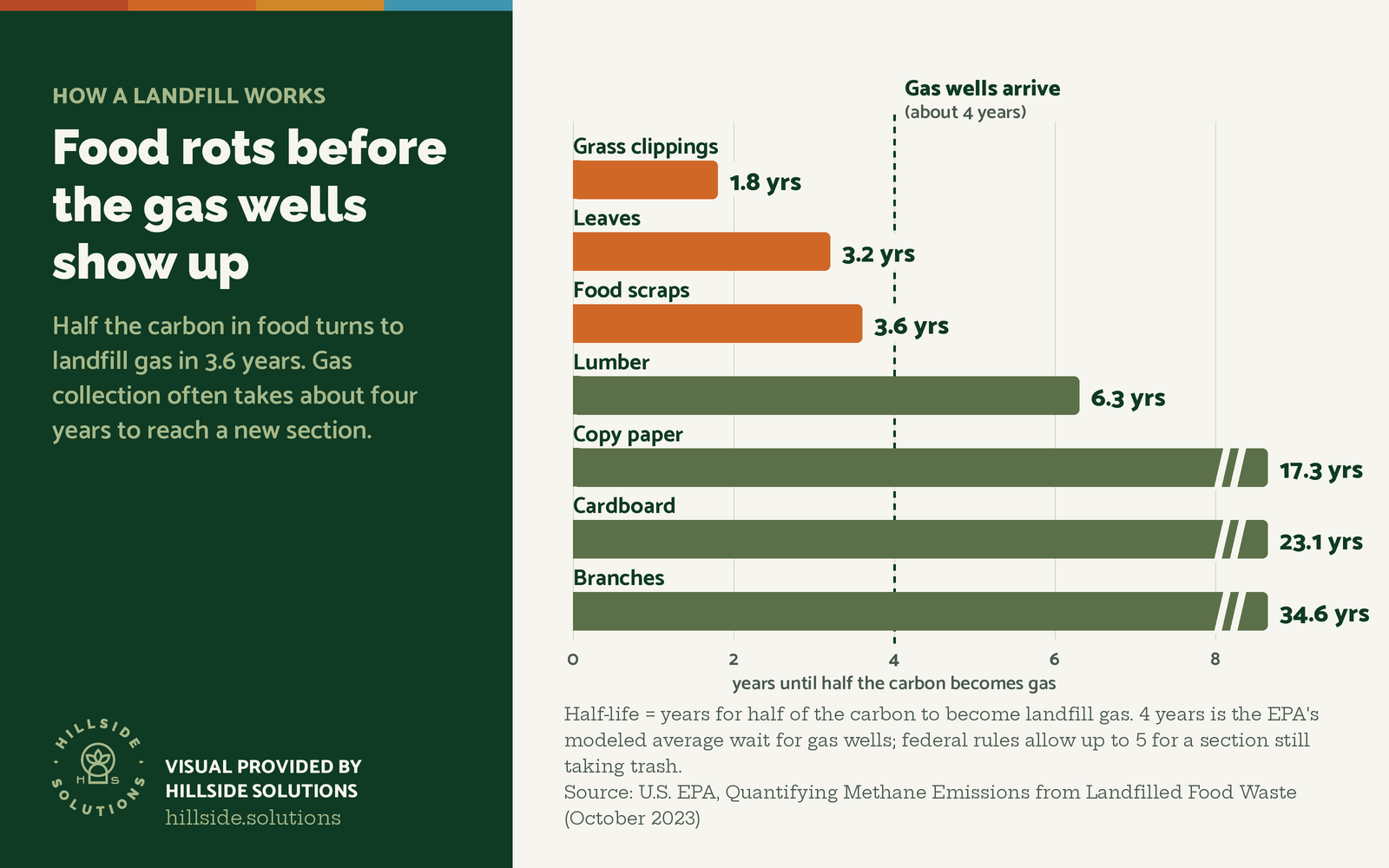
Federal rules give landfills time to do that. A section that's still taking trash can go up to five years before gas collection has to reach it. In its 2023 study on food waste and landfill methane, the EPA assumed a four-year gap on average.
Food doesn't wait four years
Food rots fast. The EPA found that half of the carbon in food waste turns into landfill gas within 3.6 years. Most of the gas comes off while the cell is still open and the wells aren't in yet.
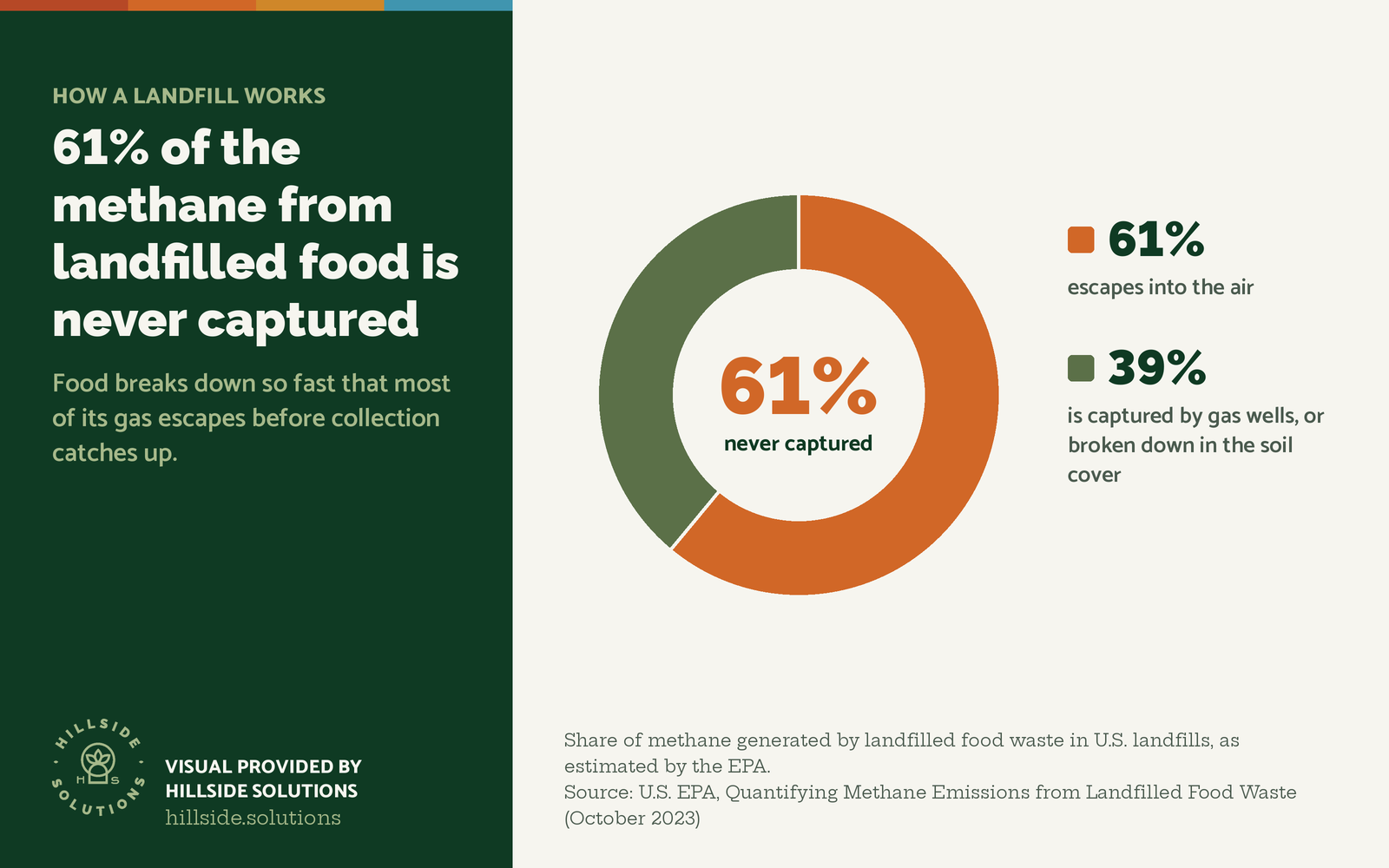
That's why the EPA estimates 61% of the methane from landfilled food waste is never captured. Food is about 24% of what goes into U.S. landfills, but it's responsible for an estimated 58% of the methane that escapes them.
Gas capture does much better with things that break down slowly. Half the carbon in cardboard takes about 23 years to turn into gas, and copy paper about 17. By then, the wells have been in place for a long time. (Cardboard and paper are better off recycled anyway, but that's a different post.)
Omaha has had this debate about yard waste
In 2017, the City of Omaha looked at sending yard waste to the landfill with the trash. The study behind it, by SCS Engineers, found that landfilling yard waste "will result in additional landfill gas available for electrical generation," according to the city's announcement.
The same study found that landfilling yard waste had "marginally higher" greenhouse gas emissions than composting it, and would shorten the landfill's life by about 3.8%.
Since then, the EPA's numbers have made the timing problem clearer. Grass clippings break down even faster than food, with half their carbon turned to gas in 1.8 years. Leaves take 3.2 years. Most of that gas comes off before the wells go in. Branches are the exception (about 35 years), and they're also the easiest yard waste to chip into mulch.
Omaha still bans yard waste from the landfill in May and June, and again from October through December.
What gas capture is good for
Landfill gas capture deals with what's already in the ground. Every landfill should have it, and the more methane it catches, the better.
It doesn't make the landfill a good place for food. Even with the best system running, most of the methane from food escapes before the wells reach it. And whatever gets captured, the food itself is gone for good, buried in a cell that will sit there for decades.
Composting works differently from the start. The piles get turned so air keeps moving through them, and the microbes that need oxygen do the work. They give off mostly carbon dioxide, and the finished compost goes back on Nebraska farm fields and gardens as soil.
The numbers are big. Nebraska's 2025 statewide trash study estimates that about 238,000 tons of food scraps and food-soiled paper went to Nebraska landfills in a single year. The study's companion analysis found that diverting the recyclables and compostables Nebraska buries each year, about 580,000 tons, would cut 872,264 metric tons of greenhouse gas emissions (CO2 equivalent). That's equal to the yearly energy use of 117,142 households.
The state wants more compost on its fields, too. In its 2026 report, the Governor's Water Quality and Quantity Task Force listed an "increase in acres with sampled manure or compost applied" as one of its measures of progress on soil health. Here's our breakdown of what the task force said about compost.
What you can do
At home: The Curbside Compost Club picks up your food scraps every week, right from your curb. Meat, dairy and bones included. It all goes to Soil Dynamics and comes back as soil.
At work: Restaurants, offices, schools and event venues throw away food by the dumpster-load. We can set up commercial composting for your business, whether that's one break room or a whole building.
In your yard: We'd love to compost your grass, but the best place for clippings is right where they fall. Leave them on the lawn after you mow, and they'll break down in a few weeks and feed the grass. Keep leaves and branches out of the trash cart during Omaha's ban months, and ask your hauler about yard waste pickup.
The gas plant at Pheasant Point will keep running either way. You can start with the Compost Club or talk to us about your business.
Sources
U.S. EPA, Quantifying Methane Emissions from Landfilled Food Waste (October 2023), pages iii, 5, 6, 9 and 13
OPPD, The Wire: Elk City Station (July 2019)
WOWT, WM opens Omaha-area facility that turns landfill gas into home fuel (May 14, 2026)
City of Omaha, Study Measures Economic, Environmental Aspects of Yard Waste Collection and Disposal (January 12, 2017)
Nebraska DWEE, 2025 Nebraska Statewide Material Characterization Study, plus the WARM Analysis report (SCS Engineers, 2026)
Governor's Water Quality and Quantity Task Force, Final Report (2026), page 30
U.S. EPA, Criteria for Municipal Solid Waste Landfills, 40 CFR Part 258 (liners, leachate collection, daily cover)
IPCC Sixth Assessment Report (2021), methane's 20-year global warming potential