
Featured on WOWT: how Omaha food scraps end up on Nebraska farm fields
WOWT news article covering our Curbside Compost Club program.
WOWT 6 News covered the Curbside Compost Club this week — Omaha's curbside composting program that collects your food scraps and yard waste and turns them into compost for Nebraska farms. Reporter Olivia Reed visited in the program's fourth month, with more than 380 Omaha homes on board and a goal of 1,600.
One of our residential members nailed it with this quote:
"Part of the importance of this program is that it does go directly to farms. And with oil prices being higher, fertilizer prices are higher, this program will help to mitigate the cost of synthetic nitrogen sources, as well as helping to rebuild soil that has maybe been depleted over the years."
We haven’t talked about the “directly to farms” part enough yet, so we’re going to unpack it here …
Most residential compost programs don't do this
Food scraps collected in Omaha fed this grain field in a nearby farm.
Curbside composting itself isn't new. San Francisco has been collecting residential food scraps for 30 years. New York rolled out curbside composting citywide. Subscription services like ours run in dozens of American cities.
But follow the finished compost and the story usually ends somewhere small. When the US Composting Council surveyed compost manufacturers, landscaping took about 40% of everything made. Farms took about 10%. The largest food-waste collector in the country reports that less than 5% of its compost sales reach agriculture at all. The rest goes to community gardens, city landscaping, topsoil blends, or a bag you can buy back for your tomatoes. All good things. But most don't tackle the biggest food garden of all: our industrial farming complex.
San Francisco is the big exception, and it deserves credit. Recology, the company behind that city's green bins, sends compost to more than 200 Napa vineyards and trucks hundreds of loads a month to almond, pistachio and walnut orchards in the Central Valley. Food scraps on working farms, at a scale we can only admire. It's also high-value permanent crops, in a state where 65% of all compost already goes to agriculture, rather than the corn and soybean ground that covers most of the Midwest.
A handful of subscription services around the country do get compost to local farms. We found programs in Maine, Brooklyn, Phoenix, Nashville, and Chicago doing versions of it, usually supplying urban farms and market gardens. Good work, small acreage.
The idea itself is catching on in our corner of the map. Fifty miles east in Woodbine, Iowa, a new facility opened this summer with a $3.9 million USDA grant to turn livestock manure and food-processing byproducts into row-crop fertilizer, for exactly the reason we care about: less liquid nitrogen on fields, fewer nitrates in the water. The composting industry's own trade group said this spring that "mid-size row cropping takes a bit longer to roll out." The Midwest isn't waiting.
What we haven't found is another residential program built to put food scraps on working row-crop fields, at farm scale, with the stated goal of cutting synthetic nitrogen. The Woodbine facility takes industrial and farm streams. Ours starts at your kitchen counter. If someone else has a city's households feeding a system like this, please let us know. We'd like to compare notes.
So when your neighbor asks what's different about the green cart, the answer is the destination.
What happens after we pick up your cart
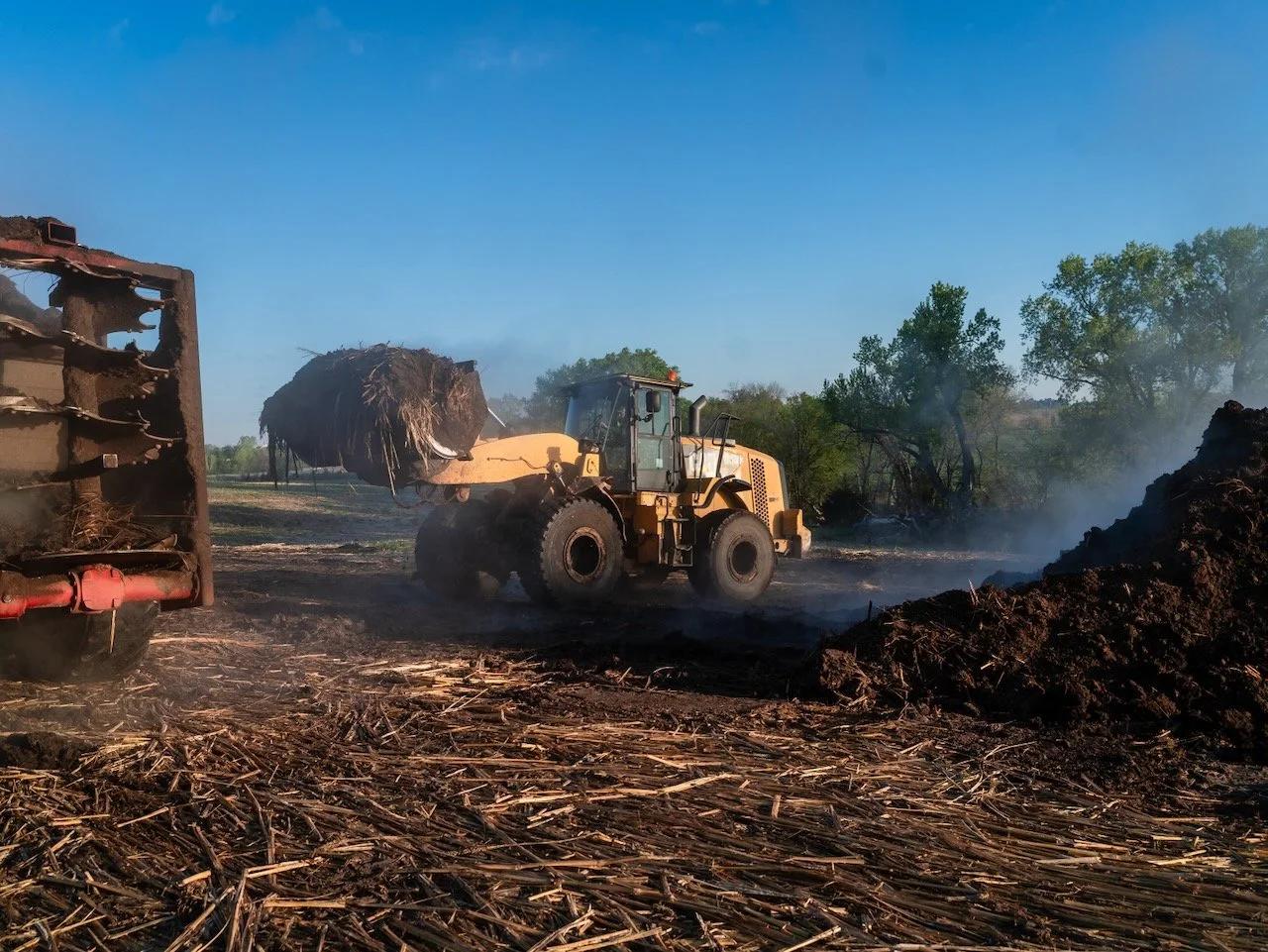
Your cart goes to Soil Dynamics. The crew there pulls out anything that isn't organic (the occasional fork or plastic bag), grinds everything up to speed decomposition, and lets it pre-compost for a stretch. Then it's loaded and delivered to participating Nebraska farms, where it finishes breaking down in the field itself. The organic matter and nutrients go to work in the farmer's soil instead of sitting in a windrow at our facility.
That's our On-Farm Organics Management program, run in partnership with the Hillside Fund, a nonprofit testing these practices on real Nebraska farm ground. The result for the farmer: less reliance on synthetic fertilizer. The result downstream: fewer nitrates headed into the soil and, eventually, the water. Nitrates in Nebraska's well water have been climbing for years, and over-application of nitrogen on row crops is a primary source.
One caveat. Compost doesn't replace nitrogen one-for-one on a corn field, and agronomists who've studied it still recommend some commercial nitrogen alongside. What the material does is cut how much a farmer needs, feed the soil biology, and add phosphorus and organic matter that synthetic fertilizer never will. "Less" is the right word. It's a big word when Nebraska's water is what's at stake.
The proof is already growing
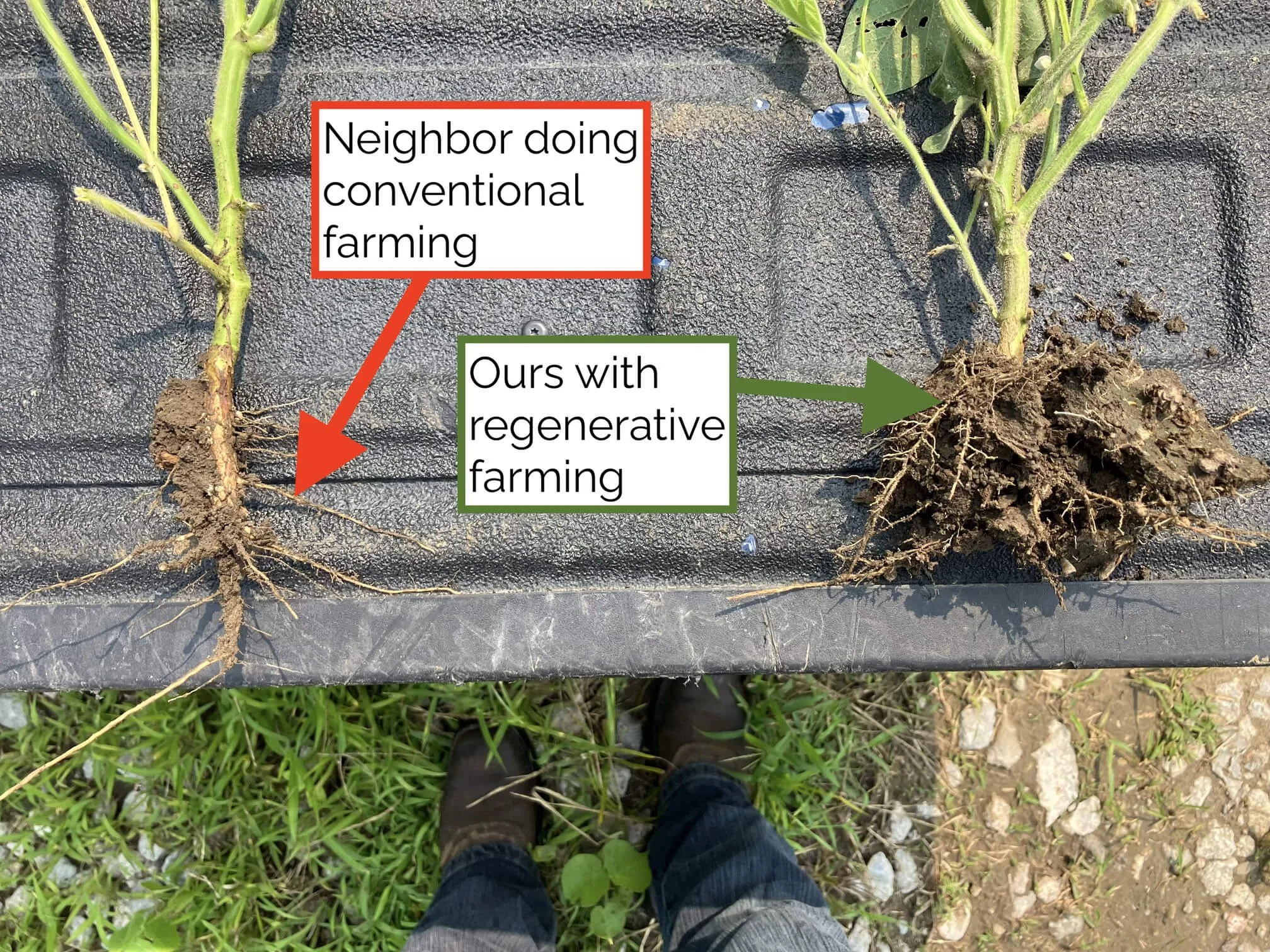
On the Fund's farm near Gretna, two soybean fields were planted the same day, side by side. One grew with synthetic fertilizers. The other was managed with natural soil-building practices, using the same kinds of organic material your cart provides.
The regenerative field produced 50 bushels in a drought year. The plants had deeper roots, earthworms clinging to them, and held up better late in the season. You can see the field comparison, worms and all, on the Hillside Fund farm page.
We're not the only ones seeing it.
Outside Toronto, the Region of Peel ran field-scale trials of compost made from municipal food scraps on corn, soybeans and wheat. On sandy ground, corn yields went up about 5.5 bushels an acre and wheat went up 15. Participating farmers cut their commercial fertilizer anywhere from half to all of it. The provincial agronomist was more cautious than the farmers, which is probably how it should be. Either way: the material works on the crops Nebraska grows.
Where food scraps go without the cart
Every food scrap that doesn't go in a green cart ends up somewhere, and around Omaha that's usually the landfill. Nebraska's first statewide trash study since 2009 found food is the single biggest thing we throw away. Nebraska landfills took in about 238,000 tons of food scraps and food-soiled paper in one year. Here's what the study found.
The landfill near Bennington captures its methane and turns it into energy, and that's good. Food breaks down too fast for it, though. Most of its methane comes off before the gas wells go in, and the EPA estimates 61% of the methane from landfilled food is never captured. Here's how a landfill works, and why.
What your cart does, in one sentence
You hand us banana peels and grass clippings. A Nebraska farm family spends less on fertilizer, their soil comes back to life, and the water downstream gets cleaner.
As of writing this, more than 380 Omaha homes are doing it. We're aiming for 1,600, and every cart makes the farm side work better, because organics at field scale takes volume only a whole city can provide.