
Where to Recycle Pumpkins in Omaha (Free Drop-Off, Nov 2026)
Updated October 2026 for this year's drop-off dates.
Halloween's over, the candles are out, and your jack-o'-lantern is starting to slump on the porch. Don't toss it in the trash cart. Bring it to one of our three free community pumpkin drop-offs and we'll keep it out of the landfill.
Free pumpkin drop-off sites: November 1–15, 2026
Hurrdat One stopped by the Dundee Bank location to demonstrate how dropping off pumpkins and gourds works.
Dundee Bank (Omaha)
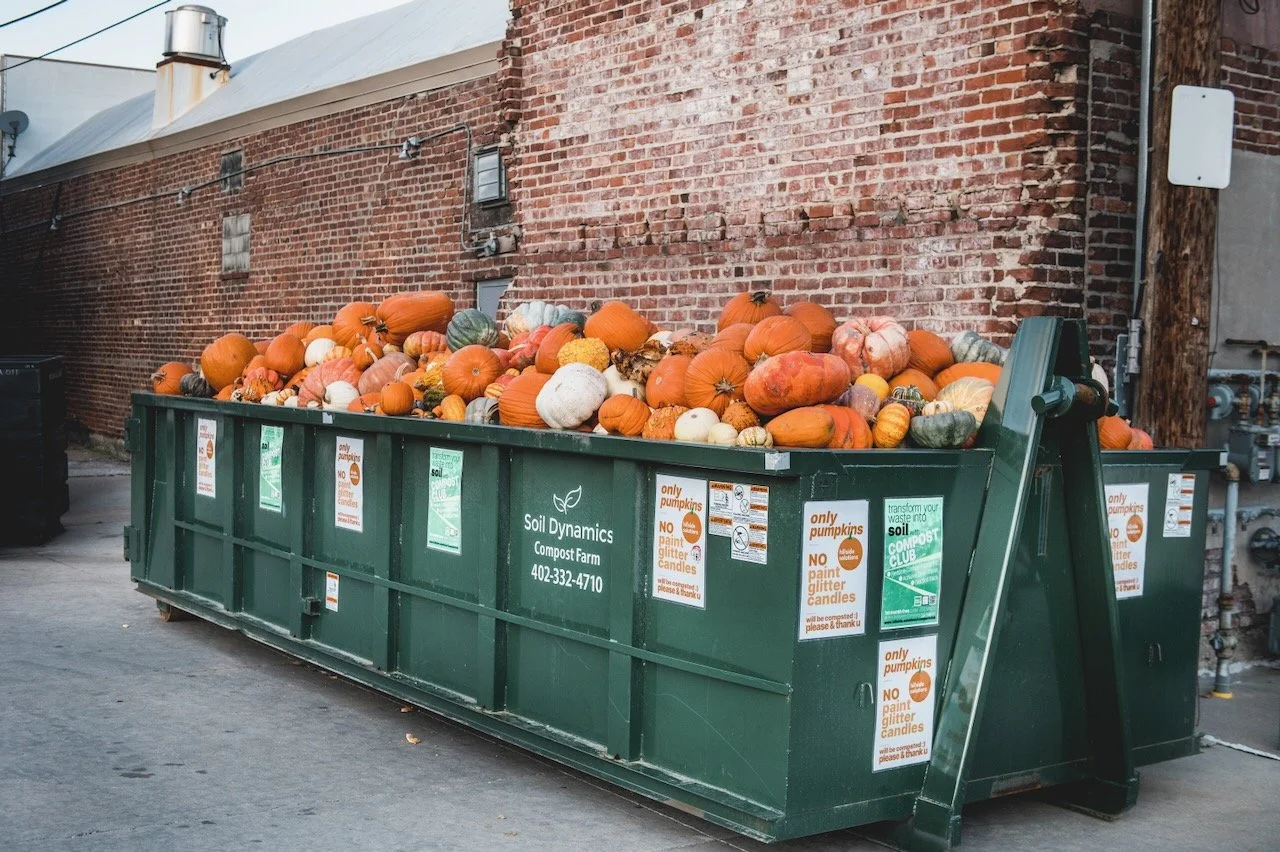
Where: 5015 Underwood Ave, Omaha, NE 68132 (look for the large roll-off container in the parking lot)
When: November 1–15, 2026, open 24/7
Where they go: Blu Wahle's family pig farm near McClelland, Iowa
NeighborGood Community Pantry (Papillion)
Where: 1712 Charleston Dr, Papillion, NE 68133 (look for the drop-off container outside the pantry)
When: November 1–15, 2026, open 24/7
Where they go: Soil Dynamics, to be composted into soil
Gretna Sanitation (Gretna)
Where: 21736 Williams Cir, Gretna, NE (place your pumpkins in the large yard waste roll-off)
When: Now through November 15, 2026
Where they go: Soil Dynamics, to be composted into soil
Bonus: Bring your recycling too. Gretna Sanitation's free recycling drop-off is open year-round and also takes glass bottles and batteries.
All three sites are free and open to everyone. No sign-up, no membership. Pull in, drop your pumpkins in the container, and you're done. Bring the kids. Bring your neighbor's pumpkins too.
Big thanks to Dundee Bank and NeighborGood Community Pantry for hosting again this year. KMTV 3 News Now covered the Dundee drop-off back in 2023 if you want to see it in action.
What you can drop off
Pumpkins (carved or whole)
Gourds and decorative squash
Please take these off first
Candles, wax, and tea lights
Stickers, pins, wire, and any plastic decorations
Plastic bags (dump the pumpkins out and take the bag home)
Please don't bring
Painted, glittered, or bleached pumpkins (paint, glitter, and bleach aren't safe for pigs and don't belong in compost)
Straw bales, corn stalks, and fake pumpkins
Where your pumpkin goes next
It depends on where you drop it. Pumpkins left at Dundee Bank go to Blu Wahle's family farm near McClelland, Iowa, where his heritage pigs get a fall feast. Pumpkins left at NeighborGood or Gretna Sanitation go to Soil Dynamics, where they're composted into soil for Omaha-area yards and gardens. Either way, they stay out of the landfill.
Meet the farmer: Blu Wahle
Blu is the fifth generation of his family to raise animals on their land near McClelland, Iowa, and his kids will be the sixth. The Wahles raise Mangalitsa hogs, a heritage breed from Hungary that was close to disappearing about 15 years ago. Blu is a member of the Mangalitsa Breed Organization and Registry, which helps farmers breed the pigs responsibly and keep the breed going for future generations.
His pigs live outside with plenty of room to roam, root and forage, and as a lard breed, they thrive in cold Midwest winters. Mangalitsas take 18 to 24 months to raise, compared with 5 or 6 months for a typical farm pig, so a good, varied diet matters. In the fall, Blu feeds them local black walnuts and acorns. Your jack-o'-lanterns add even more variety, and in Blu's words, the pigs "absolutely love them."
Blu's pigs are raised with care from day one. When it's time for piglets, the mothers give birth outside in huts or in roomy barn pens, and the babies stay with their mothers for 6 to 8 weeks or longer. This spring, the Wahles are expanding the farm so the pigs can rotate through more pasture.
So where does it all end up? Blu puts it simply: if you want to save a rare breed like this, people have to eat it. Mangalitsa pork is dark red and richly marbled, and the best of it becomes salami and dry-cured ham made by Tony Incontro of Incontro Cured in Lincoln (they also have a shop in West Omaha). The hams cure for 18 to 24 months, so the trip from farm to plate can take up to four years, all of it between Council Bluffs and Lincoln.
Fun connection: Blu also runs Wahle, Inc., a hardscape company that has used Soil Dynamics compost to build rain gardens and bioswales and to restore soil on urban conservation projects.
Watch last year's pumpkins make the trip from Dundee Bank to a local pig farm.
3 reasons pumpkins don't belong in the landfill
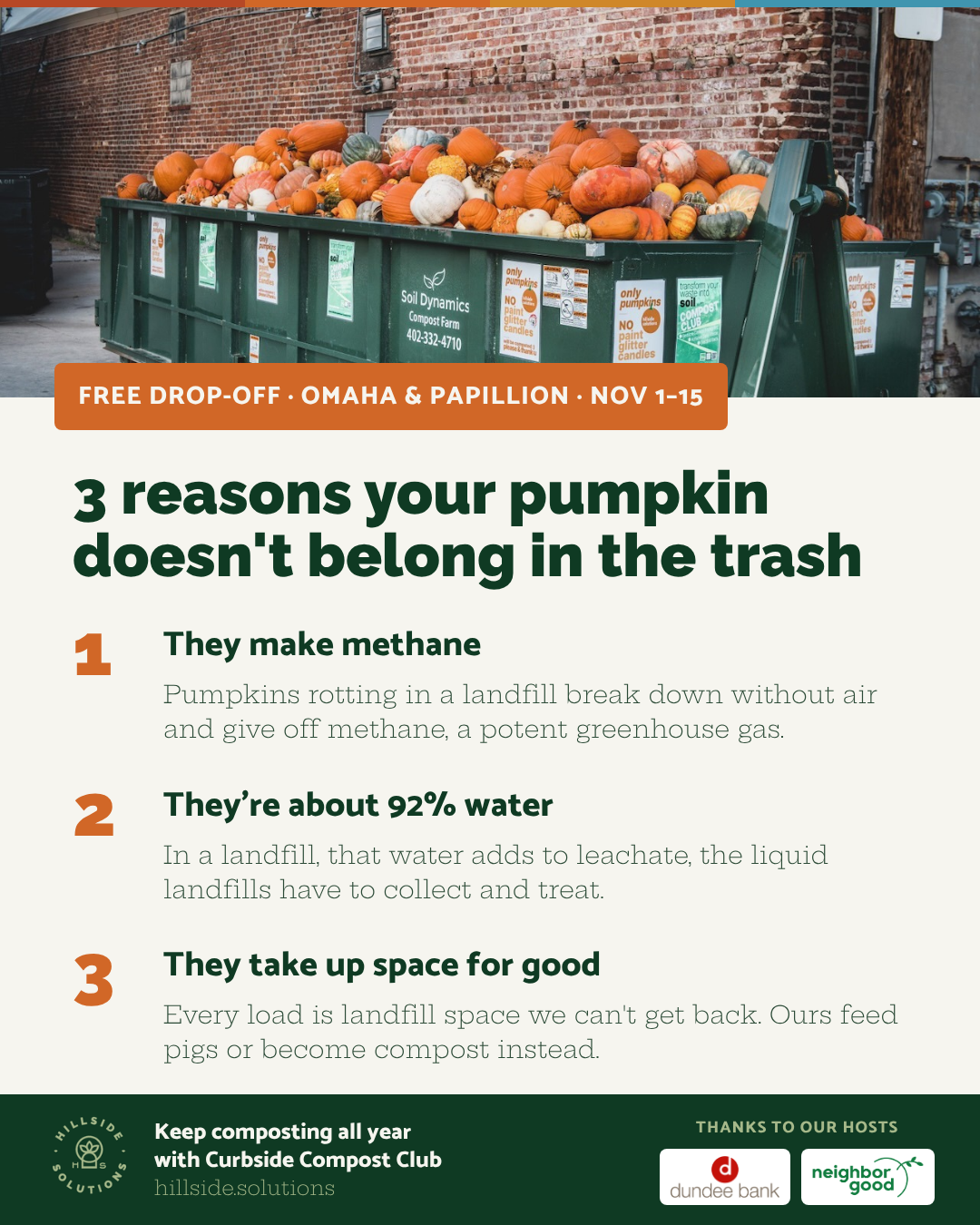
1. They make methane. Food that rots in a landfill breaks down without air, which creates methane, a greenhouse gas far more potent than carbon dioxide in the short term. The EPA lists landfills as one of the largest human-related sources of methane in the U.S. Fed to pigs or composted, the same pumpkin becomes food or soil instead.
2. They're mostly water. A raw pumpkin is about 92% water (USDA FoodData Central). In a landfill, that moisture adds to leachate, the liquid that landfills have to collect and treat. Fed to pigs or composted, that water is useful instead of a problem.
3. They take up space we can't get back. Every load of pumpkins is landfill space that's gone for good. Composting them keeps that space for the stuff that can't go anywhere else.
Can't make it to a drop-off? 9 other ways to use your pumpkins
Eat them
Pumpkin flesh works in soups, curries, bread, and pie, and you can roast the seeds with a little salt. Pretty much the whole pumpkin is edible except the stalk (here's a guide). Skip this one for carved pumpkins that sat out for a week.
Feed the critters
Chop an uncarved pumpkin into chunks and set it out for backyard wildlife, or offer it to a neighbor with chickens.
Save the seeds
Dry a handful and plant them next spring (how to plant pumpkin seeds).
Make a bird feeder
Cut a small pumpkin in half, scoop it out, fill it with birdseed, and hang it from a branch (kids' how-to).
Save it for Thanksgiving
An uncarved pumpkin can easily last until late November. Move it to the table as a centerpiece.
Turn it into a vase
Hollow out the top, drop in a jar of water, and add flowers (pumpkin vase ideas).
Make a face mask
Mashed pumpkin mixed with honey is a popular DIY face mask. (Patch test first.)
Go pumpkin bowling
Line up empty plastic bottles in the driveway and roll away (more Halloween party games).
Make your own pumpkin spice latte
Real pumpkin, real spice, way cheaper than the drive-thru (recipe).
When you're done with all of the above, the leftovers can still go in either drop-off container (Nov 1–15) or your compost.
Compost doesn't stop after Halloween
The pumpkin drop-off runs two weeks a year. Your kitchen makes food scraps every day. Two ways to keep composting year-round:
Curbside Compost Club: We pick up your food scraps right from your curb, every week, all year. Check if your neighborhood is in our service area.
Compost Club drop-off: Bring your food scraps and yard waste to members-only drop-off sites across Omaha, 24/7, for $10 a month or $105 a year. Members get 3 cubic feet of compost credits each year, plus 20% off at Soil Dynamics.
Either way, next year's jack-o'-lantern can go straight into your cart or your drop-off bin.
Raking leaves this week too? Here's how the City of Omaha's free yard waste pickup works, with a printable cheat sheet.
Hosting your own pumpkin drop at your business, school, or church? We wrote a guide on how to host a pumpkin drop.
Pumpkin drop-off FAQ
Are the pumpkin drop-offs free?
Yes. All three sites are free and open to everyone from November 1 to 15, 2026. You don't need a Compost Club membership.
What hours can I drop off pumpkins?
The Dundee Bank and NeighborGood drop-offs are open 24/7 through November 15. At Dundee Bank (5015 Underwood Ave, Omaha), look for the roll-off container in the parking lot. At NeighborGood Community Pantry (1712 Charleston Dr, Papillion), the container is right outside the pantry. At Gretna Sanitation (21736 Williams Cir, Gretna), place your pumpkins in the large yard waste roll-off.
Can I bring carved or soft pumpkins?
Yes. Carved and soft pumpkins are fine. Just pull out candles and anything that isn't pumpkin.
Can I bring painted pumpkins?
No. Paint, glitter, and bleach aren't safe for pigs and don't belong in compost. Those go in the trash.
What happens to the pumpkins?
Pumpkins from Dundee Bank go to Blu Wahle's family pig farm near McClelland, Iowa. Pumpkins from NeighborGood in Papillion and Gretna Sanitation in Gretna are composted at Soil Dynamics into soil for Omaha-area yards and gardens.
Can I compost pumpkins after November 15?
Yes, if you're a Compost Club member. Curbside Compost Club members can put pumpkins in their weekly cart, and drop-off members can bring them to any Compost Club site year-round. A backyard compost pile works too (chop it up first so it breaks down faster).