
Food Is Nebraska's #1 Trash Item, and We're Throwing Away More Than Ever
The short version: In July 2026, the Nebraska Department of Water, Energy, and Environment (DWEE) released its first statewide trash study since 2009. Crews sorted 606 samples of trash by hand at eight landfills and transfer stations across all four seasons. Food came out as the single biggest item in Nebraska's trash. Nebraska landfills now take in about 7.5 pounds per resident per day, up from 6.3 in 2009. If you live or run a business in the Omaha metro, you can do something about both numbers this week.
The state just sorted our trash. By hand.
Picture a crew in safety vests at a landfill, pulling bags off a pile, ripping them open and sorting every item into one of 65 categories. Cardboard. Diapers. Vape pens. Half a head of lettuce still in the bag.
That's how the 2025 Nebraska Statewide Material Characterization Study was done. An EPA grant of $612,000 paid for it. The work ran from late 2024 through 2025, and the report came out on July 8, 2026.
The last time Nebraska did this was 2009, which makes this the best picture we've had of what Nebraskans throw away in 16 years. As far as we can tell, nobody in the Omaha area has broken it down yet. So here it is.
Food tops the list. Everywhere.
The study looked at trash from homes, from businesses and institutions, and from mixed loads. Unpackaged food waste ranked #1 in every one of those groups.
Add in packaged food (the bag of salad that went off, the case of snack bars past their date) and food makes up 19.1% of everything sent to Nebraska landfills. Throw in yard waste and you get all organics: 27% of the waste stream, up from 19.5% in 2009.
The state's own analysis estimates that roughly 238,000 tons of food waste and food-soiled paper went to Nebraska landfills in a single year, all of it material the state classed as compostable.
A caveat on that jump: part of the reason organics take up a bigger share now is that paper takes up a much smaller one. Paper went from 41% of the trash in 2009 to 18% today (fewer newspapers, more recycling). That makes everything else a bigger slice of the pie. Food was still the top single item either way.
7.5 pounds a day, up from 6.3
The study also compared how much gets landfilled per person:
2009: 6.3 pounds landfilled per Nebraskan per day (2,302 a year)
2025: 7.5 pounds per day (2,744 a year)
Quick note on reading that number. It's every pound Nebraska landfills took in, divided by the number of people. Business waste is in there too, so it isn't what one person puts on the curb. Still, it went up by nearly 20%, and six of the eight sites in the study saw it rise.
What this looks like in the Omaha metro
The one Omaha-area site in the study was the Pheasant Point Landfill in Bennington. Here's what turned up there:
29.6% of the trash was food and yard waste, second only to Lincoln's Bluff Road Landfill (30.0%) among the eight sites.
Landfilled waste per person rose from 6.4 lbs a day in 2009 to 7.3 lbs.
Compare that with Lincoln's Bluff Road Landfill, which dropped from 5.6 lbs a day to 4.0, the lowest of any site in the study. Lincoln landfills a little over half as much per person as the Omaha area does.
The season matters too. Across the state, organics made up 36% of trash in the fall, more than in any other season. So right now, with leaves coming down, pumpkins going soft and Thanksgiving on the way, more than a third of what goes into Nebraska's bins could become soil instead.
The easy fix: compost it
Food is the biggest item, so it's also the biggest opportunity. Composting turns it into soil that goes back onto Nebraska farm fields and gardens, where it holds water and feeds crops.
The study estimates that about 74% of Nebraskans already live somewhere a food-scrap composting service is available.
At home: The Curbside Compost Club picks up your food scraps every week, right from your curb. That includes meat, dairy and bones, the stuff a backyard pile can't handle. Your cart goes to Soil Dynamics, where it's turned into finished compost.
At work: Restaurants, offices, schools and event venues produce food waste by the dumpster-load. We set up commercial composting for businesses across the metro, from a single break room to a 13-story office tower. (National Indemnity's downtown Omaha headquarters now keeps about 50,000 pounds of compostable material a year out of the landfill.)
What Omaha organizations and homes are already doing about it
The state's "up to 83%" is a best case. A few Omaha organizations we work with are already there, or close. (The year shown is when each number was recorded.)
HDR (2025): At its November event at CHI Health Center, 96.1% of 8,673 pounds of material was composted or recycled. Only 341 pounds went to the landfill.
Marian High School (2023): 91% of lunchroom waste stayed out of the landfill, about 15,000 pounds a year.
Baxter Subaru (2023): Went from 96 yards of trash a week to 8, and recycles or composts over 90% of its waste.
Elmwood Tower (2025): Swapped a 28-yard trash compactor for an 8-yard dumpster on the same pickup schedule. That's about 70% less trash.
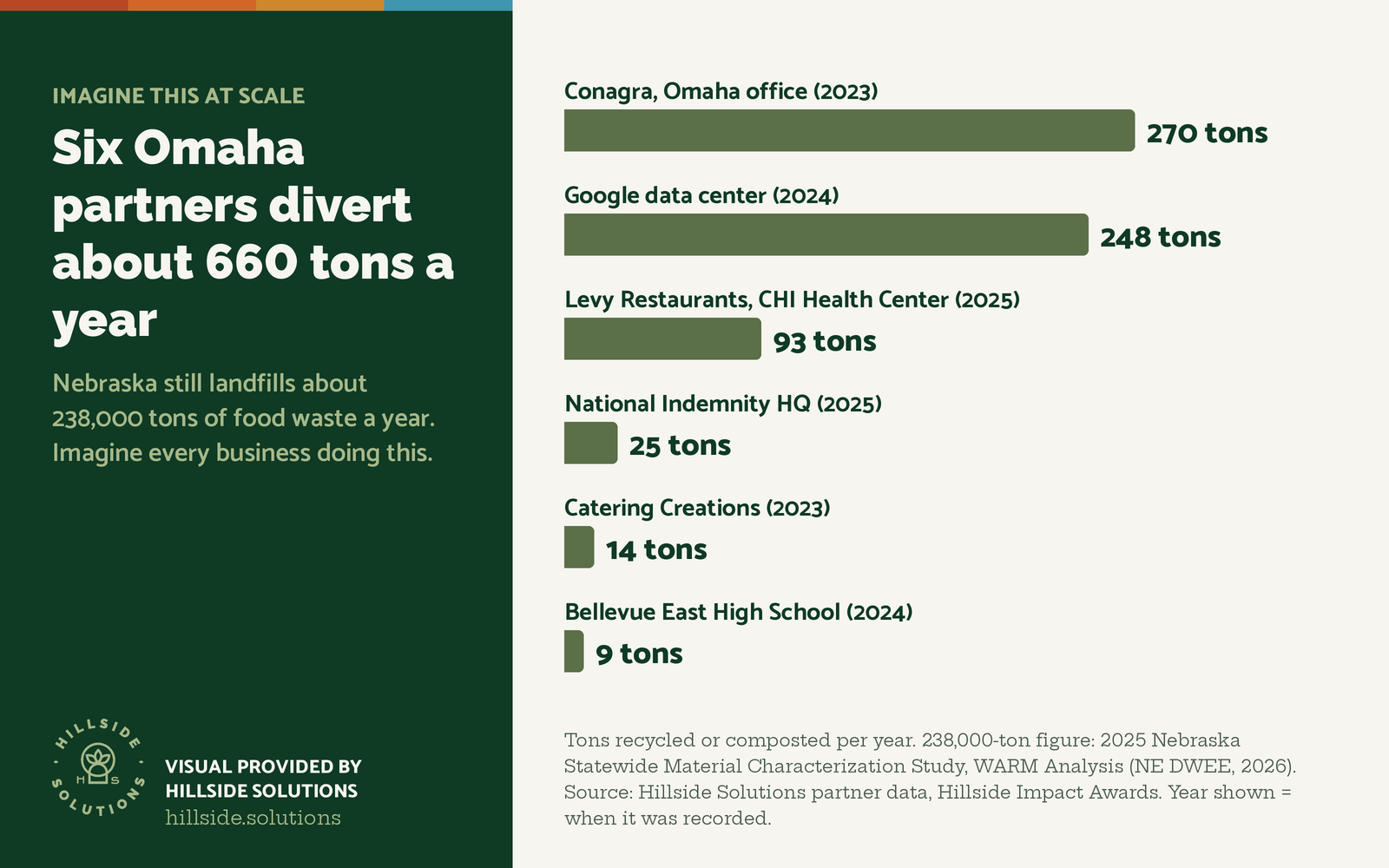
Conagra's Omaha office (2023), Google's data center (2024) and Levy Restaurants at CHI Health Center (2025): 270 tons, 248 tons and 93 tons a year recycled or composted.
Homes are adding up too. Since the Curbside Compost Club launched in April 2026, crews have picked up 5,342 carts. The average cart weighs 34.4 pounds (from 27 route days we ran across the scale at Soil Dynamics). That's 92 tons, about 184,000 pounds, kept out of the landfill through September 30, 2026, and the club is on pace for about 320 tons a year.
Six of the organizations above divert about 660 tons a year between them. Nebraska still sends about 238,000 tons of food waste to landfills every year. Imagine every business in the state doing what these partners already do.
Next on the list: cardboard
Among the study's recommendations, the state suggests Nebraska "may consider implementing a disposal ban on readily recoverable material such as Corrugated Cardboard."
In other words, keep clean cardboard out of the landfill altogether.
Lincoln has done exactly that since 2018. Since April 1 of that year, clean, dry corrugated cardboard hasn't been allowed in Lincoln's landfill. Before the ban, cardboard was about 9.5% of what collectors hauled there, the largest single recyclable going into the ground. In the first year, the amount of cardboard landfilled in Lincoln dropped 76% (Waste Dive). Wisconsin bans corrugated cardboard from its landfills statewide.
Statewide, cardboard is still 5.3% of what Nebraska buries. Every one of those boxes already has a place to go. Cardboard is one of the easiest materials to recycle, and it gets turned into new boxes.
If you run a business, you probably already know how much cardboard comes through your back door. Recycling isn't required for Nebraska businesses today, so most of it ends up wherever the dumpster goes. A dedicated cardboard and recycling service usually takes a big load off your trash dumpster, and it means nothing changes for you if Nebraska follows Lincoln's lead.
The question no one is tracking yet
One recommendation in the report caught our eye. The state suggests requiring landfills to report where their waste comes from, which means that today, nobody officially tracks it.
Not every county has a place to put its trash. Cass County, just south of Omaha, doesn't have a permitted landfill or transfer station on the state's list, so its trash is trucked to a landfill in another county.
Every community makes trash and food scraps. Someone, somewhere, is handling them. We think Nebraskans deserve a clear picture of where all of it goes, and we'll be digging into that in upcoming posts.
What you can do this month
Pull the food out of your trash. At home, join the Curbside Compost Club. At work, ask us about commercial composting.
Break down your boxes and recycle them. Clean, dry cardboard is one of the easiest things to keep out of the landfill.
Take a look at your dumpster. If you manage a building or a business, open the lid on a Friday afternoon. Most of what you see is food, cardboard or both.
Read the study yourself. The full report is free on DWEE's website, with tables for every site and season.
Whether it's your kitchen or your loading dock, we can help you take the biggest items out of your trash. Start with the Compost Club or talk to us about your business.
Frequently asked questions
What is the most common item in Nebraska's trash?
Unpackaged food waste. It was the #1 item in household trash, business trash and mixed loads in the 2025 Nebraska Statewide Material Characterization Study, at 16.4% of all landfilled waste. Including packaged food, food makes up 19.1%.
How much trash does each Nebraskan throw away per day?
Nebraska landfills took in about 7.5 pounds of waste per resident per day in 2025, up from 6.3 pounds in 2009. That figure includes business waste, so it's an average across the state, not a measure of one household.
Does Nebraska ban cardboard from landfills?
Not statewide. Lincoln has banned clean, dry corrugated cardboard from its landfill since April 1, 2018. The 2026 state study suggests Nebraska consider a statewide cardboard disposal ban.
Can I compost food waste in Omaha?
Yes. Curbside pickup services like the Curbside Compost Club collect food scraps (including meat, dairy and bones) from homes, and commercial composting services collect from businesses.
Sources
Nebraska DWEE, 2025 Nebraska Statewide Material Characterization Study (prepared by SCS Engineers, June 2026), plus the companion Recoverability Analysis and WARM Analysis reports
Nebraska DWEE, press release, July 28, 2026
City of Lincoln, Corrugated Cardboard Disposal Ban
Waste Dive, Lincoln, Nebraska's cardboard disposal decreases dramatically following ban (April 2019)
Wisconsin DNR, What to recycle in Wisconsin
Nebraska DWEE, Integrated Waste Management list of permitted facilities