
Why Composting Matters (And Why Omaha Is Finally Doing Something About It)
Maybe your neighbor told you about it. Maybe you saw a green cart on the curb and got curious. Maybe you care about the planet — or maybe you just want your kids drinking clean water. Either way, you're in the right place. This one's for you: the person who's heard of composting but isn't totally sold yet.
The stuff in your trash can is doing more damage than you think.
Here's something most people don't know: over half of what ends up in a landfill is compostable. Food scraps, yard waste, coffee grounds, eggshells — material that could become soil is instead buried under layers of trash where it can't break down the way nature intended.
And when food waste sits in a landfill, three things happen — none of them good.
Methane. Food buried in a landfill produces methane gas, which traps heat in our atmosphere at 80 times the rate of CO2 over a 20-year period. That banana peel you tossed? In a landfill, it's contributing to climate change. In a compost system, it becomes soil.
Leachate. The moisture from decomposing food mixes with everything else in the landfill — chemicals, heavy metals, plastics — and creates a toxic sludge called leachate. That sludge can seep into groundwater and waterways. In Nebraska, where agriculture and water quality are deeply connected, this isn't abstract. It's personal.
Space. Food waste shortens the lifespan of a landfill. Building new ones is expensive, politically contentious, and increasingly difficult to site. Every banana peel and coffee filter we divert means the landfill lasts a little longer for the stuff that actually belongs there.
So what happens when you compost instead?
The short answer: your food scraps become plant food. The long answer is even better.
If you've watched Kiss The Ground on Netflix, you've seen the science: healthy soil is one of our most powerful tools against climate change. Soil that's rich in organic matter captures carbon, holds water, and grows food without relying on synthetic fertilizers. Composting is how we build that soil.
When you compost with Curbside Compost Club, your food scraps go directly to local Omaha-area farmers through our On-Farm Organics Management program. These farmers mix your food scraps into their soil management process, turning what would have been landfill waste into organic fertilizer that replaces chemical inputs.
It's a cycle that actually works. Food grows in soil. We eat the food. The scraps go back to farmers. They grow more food. Repeat.
This is also a health issue. A big one.
Here's where it gets real — especially if you live in Nebraska and drink water.
Conventional farming relies heavily on synthetic nitrogen fertilizers. When those fertilizers are over-applied (which happens a lot), the excess nitrogen doesn't just disappear. It leaches into groundwater as nitrates. And nitrates in drinking water are a serious problem in this state.
According to research cited by Hillside Fund: nearly 33,000 Nebraskans get drinking water from wells affected by nitrate contamination. A statewide study found that roughly 17% of private wells sampled had nitrate levels above the safety threshold. On average across Nebraska domestic wells, nitrate levels hover above 7 mg/L — uncomfortably close to the 10 mg/L federal limit.
And here's the part that should make every parent pay attention: University of Nebraska Medical Center studies have found that areas with higher nitrate levels in water also have higher rates of pediatric lymphoma, leukemia, and brain cancers. Nebraska now has the highest pediatric cancer rate west of Pennsylvania.
That's not a talking point. That's our neighbors' kids.
The connection to composting is direct: every pound of organic material that goes back into a farm's soil is a pound of synthetic fertilizer that farm doesn't need to buy. Less synthetic fertilizer means fewer nitrates leaching into the water table. When you compost with us, your food scraps literally replace the chemicals that are contaminating Nebraska's water supply.
Composting isn't just an environmental feel-good. It's a public health intervention.
Who's already doing this?
Omaha has been composting at scale for years — you just might not know it. Over 300 commercial partners compost with Hillside Solutions, from FNBO and HDR's headquarters to Creighton University, Methodist Hospital, and dozens of local restaurants like Archetype Coffee, Coneflower Creamery, and Kitchen Table. Over 20 schools across the metro run composting programs with us. And more than 1,800 residents already compost through Compost Club.
The evidence is clear: composting works. It's not complicated, it doesn't smell (we get asked that a lot), and the impact is real and measurable. Fontenelle Elementary went from 210 bags of trash to 21 after starting a composting program. Central High School has 3,000 students composting daily. These aren't hypotheticals — they're Omaha results.
Here's what it looks like at your house.
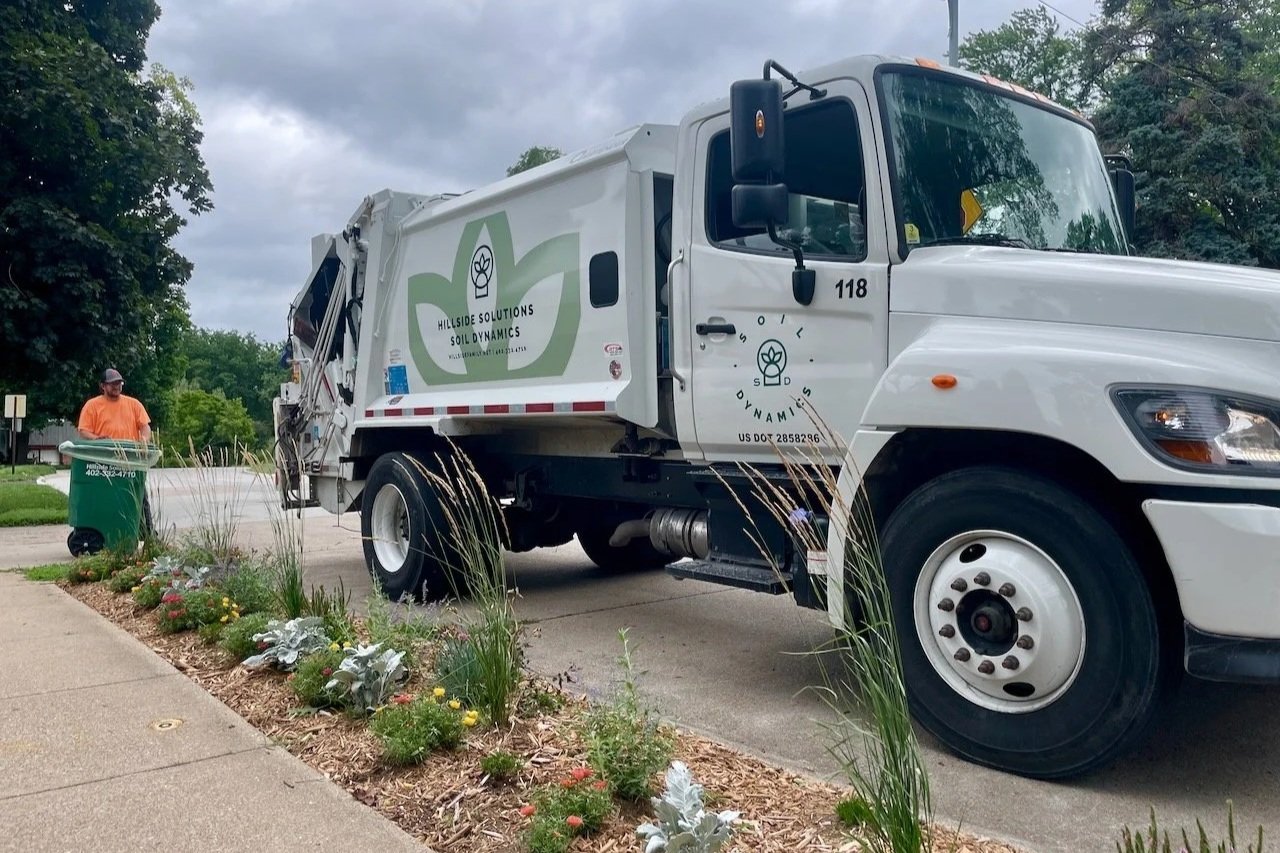
You pick a cart — 35, 65, or 95 gallons. You toss in your food scraps and yard waste. You roll it to the curb once a week. We pick it up and deliver it to local farmers.
That's it. You compost without the commute, without the backyard pile, and without having to figure out the science.
Ready?
Curbside Compost Club is a Hillside Solutions service. Hillside Fund supports the mission by making composting accessible to everyone through education and subsidized memberships.
Your food scraps have somewhere better to be than a landfill. Let's feed the soil — and protect the water while we're at it.